Beyond the Page – Thought Leadership, Insights, and Stories from the Heart of Integra
Welcome to Beyond the Page, where we go beyond publishing to bring you thought leadership, insights, and stories from the heart of Integra. Each episode features Integra’s leaders and experts as they share their vision, strategies, and experiences in shaping the future of the industry. Tune in for an exclusive look at the minds driving innovation and transformation within our organization.
Introduction
Efficiently managing peer review is essential for scholarly journals. From handling submissions to coordinating with editors and reviewers, the process requires expertise, vigilance, and the right technology. Ensuring research integrity and detecting peer review manipulation are growing concerns for publishers worldwide.
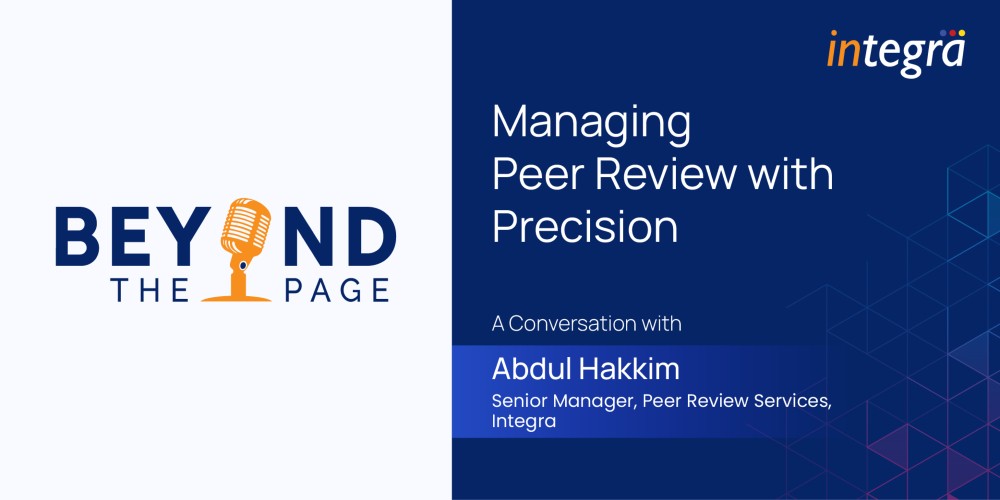
In this conversation, we sit down with Abdul Hakkim, Senior Manager, Peer Review Services at Integra, to explore how his team supports journals, navigates challenges, and leverages innovation to strengthen editorial office management.
1. Understanding Peer Review Management at Integra
Q: Abdul, can you share a bit about your role at Integra and your experience in managing peer review services?
Abdul: Yes, my role as a Senior Manager for Peer Review Services at Integra involves setting up new businesses, overseeing operations, and managing strategic accounts for publishers. I have a decade of experience in the publishing industry, with the added advantage of working in production as well. I started as an editorial assistant in 2015 and moved up the ladder to team leader and then to a managerial role, handling larger teams across locations and different functions.
Q: What are the key functions your team handles when supporting a journal’s editorial office?
Abdul: My team at Integra supports journals with end-to-end peer review management, starting from manuscript triage, editorial office and peer review administration, reviewer selection, and image forensics. At the core, we manage journal operations by providing technical and subject matter services.
Q: How does your team collaborate with journal editors, publishers, and other stakeholders to ensure smooth operations?
Abdul: Each team has defined goals and works closely with journal stakeholders to improve operational efficiency in terms of the screening process, quality of submissions, turnaround time optimization, identifying bottlenecks, and recommending strategic actions for improvement.
2. Challenges and Best Practices in Editorial Office Management
Q: What are some of the biggest challenges journals face in managing peer review and editorial workflows?
Abdul: Some of the biggest challenges journals face are maintaining the quality of submissions despite the increasing volume of manuscripts each year and ensuring the timely publication of relevant content. Balancing volume, quality, and integrity remains a key challenge.
Q: What best practices do you recommend for journals looking to improve their editorial office management?
Abdul: While a tailored approach to meet each journal’s unique needs is essential, streamlined editorial workflows in submission processing, decision-making, and other stages of peer review help maintain the journal’s operational excellence. Some best practices include ensuring up-to-date documentation of workflows, robust initial screening to prevent duplicate submissions and plagiarism, verifying author and suggested reviewer identities, automating technical checks to focus on quality, and regularly updating editorial policies to align with industry best practices from organizations such as COPE (Committee on Publication Ethics) and ICMJE (International Committee of Medical Journal Editors).
Q: How does Integra help journals streamline peer review processes and overcome challenges?
Abdul: Integra helps journals streamline peer review processes by providing expert-driven solutions, data-driven insights, and operational support. For example, we help journals find suitable reviewers for manuscripts while ensuring the highest quality and ethical standards. This reduces peer review delays, mitigates reviewer fatigue, and enhances faster decision-making for submissions. We also assess peer review risks such as reviewer identity disclosure under anonymization policies, incomplete review comments, and editorial acceptance without external review for original research.
3. Research Integrity and Detecting Peer Review Manipulation
Q: Research integrity is a critical issue in scholarly publishing. How does the peer review process help maintain high ethical standards?
Abdul: By upholding rigorous evaluation, ethical screening, and transparency, the peer review process remains the cornerstone of research integrity in scholarly publishing.
Q: What are some of the most common types of peer review manipulation that journals should be aware of?
Abdul: Some common types of peer review manipulation include citation manipulation, fake or compromised reviewer identities, peer review rings, paper mills, and inappropriate authorship changes.
Q: How does Integra assist journals in detecting and preventing unethical peer review practices, such as paper mills, fake reviewers, and conflicts of interest?
Abdul: We assist journals in detecting and preventing unethical practices by performing reviewer identity verification, checking for unusual reviewer activities and paper mill indicators, and screening for conflicts of interest (COI) declarations and ethical compliance. Our comprehensive research integrity services help journals identify and analyze integrity issues by working collaboratively with publishers.
Q: Have you encountered any real-world examples of peer review manipulation? How were they addressed?
Abdul: Yes, I have seen journals combatting submissions from paper mills trying to manipulate the peer review process with increased submissions and incomplete peer review processes. By strengthening editorial policies for submissions and peer review — including implementing mandatory institutional email IDs, avoiding author-recommended reviewers, increasing the threshold for text overlap, requiring signed authorship change forms, and conducting in-depth analysis of submissions — journals were able to address the issue effectively.
Q: How do you see AI and automation shaping the future of research integrity monitoring?
Abdul: There are many promising initiatives and developments around monitoring research integrity issues, such as data fabrication and manipulation, fake identities, predictive analysis, and tortured phrase detection. However, the outcome of AI depends on how it is used — bad actors can also exploit AI to their advantage. I believe it’s about how we use AI to combat the misuse of AI.
4. Technology and Innovation in Peer Review
Q: How is technology transforming peer review and editorial management today?
Abdul: Technology is reshaping peer review and editorial management by improving efficiency and transparency. Automated manuscript screening, AI-powered reviewer matching, and image forensics tools are becoming increasingly popular. AI-assisted peer review also seems possible.
Q: Can you share how Integra integrates AI and automation to enhance the peer review process?
Abdul: Integra’s EditorialPilot platform performs 40+ technical and research integrity checks for submissions, improving the accuracy and efficiency of editorial management. This allows editorial staff to focus on quality, timeliness, and improved communication rather than repetitive administrative tasks.
Q: What role does data and analytics play in optimizing peer review workflows?
Abdul: Real-time tracking and monitoring help address delays in peer review effectively. Data analysis helps us understand reviewer engagement, turnaround times, acceptance rates, top contributors, and editor performance. Leveraging data and analytics helps publishers monitor submission trends and plan resource allocation.
5. Future Trends and Looking Ahead
Q: In your view, how is the peer review landscape evolving? What changes do you foresee in the coming years?
Abdul: The peer review landscape is undergoing significant transformation with the rise of AI and automation in peer review workflows. I see both opportunities and threats arising from AI, and I’m excited to see how we will embrace the opportunities and handle the threats responsibly.
Q: How is Integra preparing to meet the future needs of journal publishers and editorial offices?
Abdul: We carefully understand the needs of journal publishers and listen to their feedback on managing increased submission volumes, upholding research integrity, responsible use of AI, and optimizing existing workflows. Integra’s focus on expert-driven, AI- and technology-assisted solutions positions us to meet the future needs of journal publishers.
Q: Finally, what advice would you give to journal publishers looking to enhance peer review management and safeguard research integrity?
Abdul: It’s essential to regularly assess journal editorial policies and seek feedback from others. Detecting and preventing issues is more crucial than addressing them later. Bad actors and paper mills can exploit loopholes in editorial policies, such as weak screening processes, non-streamlined submission systems, imbalanced workloads, unmonitored performance, and bypassed policies.
Conclusion
Thank you, Abdul, for sharing your expertise on managing peer review services, ensuring research integrity, and detecting manipulation. It’s clear that effective editorial office management demands operational efficiency, ethical oversight, and technological innovation.
With growing challenges in peer review and research integrity, Integra’s expertise and technology-driven approach are paving the way for a more transparent and efficient scholarly publishing ecosystem. We look forward to seeing Integra continue to lead in this space.