
Skip to Header Skip to main content Skip to Footer

Dominique de Roo of De Gruyter Brill on Truth in the Age of AI. Listen to Episode 2 of Upstream by Integra.

Listen Now

Safeguarding Research Integrity in Open Science: Balancing Transparency with Ethical Rigor

Open science is redefining how research is conducted, shared, and applied by promoting transparency, accessibility, and global collaboration. It offers an innovative framework for democratizing knowledge, enabling researchers worldwide to access datasets, methodologies, and findings without traditional barriers. However, this openness introduces complex challenges that test the boundaries of ethical rigor and research integrity.

The risks associated with open science are varied. Data misinterpretation, unauthorized usage, and weakened peer-review systems undermine research reliability. Additionally, disputes over authorship, resource inequalities, and challenges in handling sensitive information complicate equitable knowledge sharing. These issues demand solutions that balance openness with accountability.

This article explores how the academic community can proactively address these challenges by integrating ethical education, technological tools, and policy alignment into open science practices. By focusing on core principles such as data stewardship, transparent documentation, and the FAIR (Findable, Accessible, Interoperable, Reusable) framework, researchers can navigate open ecosystems responsibly. For institutions and policymakers, investing in these measures is a strategic priority to ensure the future of research integrity.

Key Challenges to Research Integrity in Open Science

Open science fundamentally reshapes research norms, emphasizing transparency and accessibility. However, these benefits come with risks to research integrity, which require careful management.

Data Misuse and Misrepresentation

Sharing data on open-access platforms encourages collaboration but exposes researchers to potential misuse. Shared datasets may be misinterpreted or altered, leading to unreliable conclusions. For instance, fragmented datasets without contextual information can result in errors that damage trust in published research.

Rebecca Hill, Head of Open Research at Taylor and Francis, in her talk at the Frankfurt Book Fair, 2024, highlighted the importance of robust data policies in addressing fabricated or manipulated data, particularly for identifying fraudulent submissions from paper mills. Journals such as the Federation of European Biochemical Societies (FEBS) have successfully implemented these policies to detect fraudulent raw data in submitted manuscripts.

Confidentiality and Sensitive Information

Open science requires the ethical handling of sensitive data, particularly in fields such as healthcare, education and social sciences. Anonymizing personal, proprietary, or culturally sensitive information and ensuring secure management are essential. Despite these precautions, breaches of confidentiality remain a significant concern.

Authorship Conflicts and Data Ownership

As datasets and research materials become more widely available, disputes over authorship and intellectual contributions can arise. Questions of data ownership and recognition challenge traditional norms and create ethical and legal dilemmas. Hill, in her presentation, noted a case in which disputes arose among researchers from multiple institutions contributing to a shared dataset. The disagreements over intellectual property delayed publication and strained relationships between collaborators.

Pressures on Reproducibility and Peer Review

The pressure to publish rapidly in open science environments can compromise reproducibility. The surge in preprints and open-access publications has led to an influx of unverified findings, further straining the peer-review process. Without robust safeguards, ensuring the reliability of published work becomes increasingly difficult. Hill also addressed the rise of re-review mills—generic, automated peer-review processes—as a threat to research integrity. Transparent peer-review models can counter these practices by increasing accountability.

Resource Disparities and Ethical Equity

Not all researchers have equal access to the tools and resources required to engage in open science effectively. This inequity creates challenges for maintaining ethical standards, as researchers in under-resourced institutions may struggle to meet the rigorous demands of transparency and reproducibility.

Table: Summary of Research Integrity Challenges and Potential Impacts

ChallengeDescriptionPotential Impact
Data MisuseMisinterpretation or manipulation of open datasets.Misleading conclusions; loss of trust in research.
Confidentiality RisksExposure of sensitive or proprietary data.Breaches of participant trust; ethical violations.
Authorship ConflictsDisputes over credit for data use and discoveries.Erosion of collaborative spirit; legal challenges.
Reproducibility PressuresLack of verification for rapidly published findings.Weakening of scientific reliability; inflated claims.
Resource DisparitiesInequitable access to open science tools and platforms.Ethical inequities; limited participation in global research.

Addressing these challenges requires not only awareness but also actionable solutions that embed ethics into the foundational practices of open science. Ethical education emerges as a critical tool in preparing researchers to meet these challenges head-on.
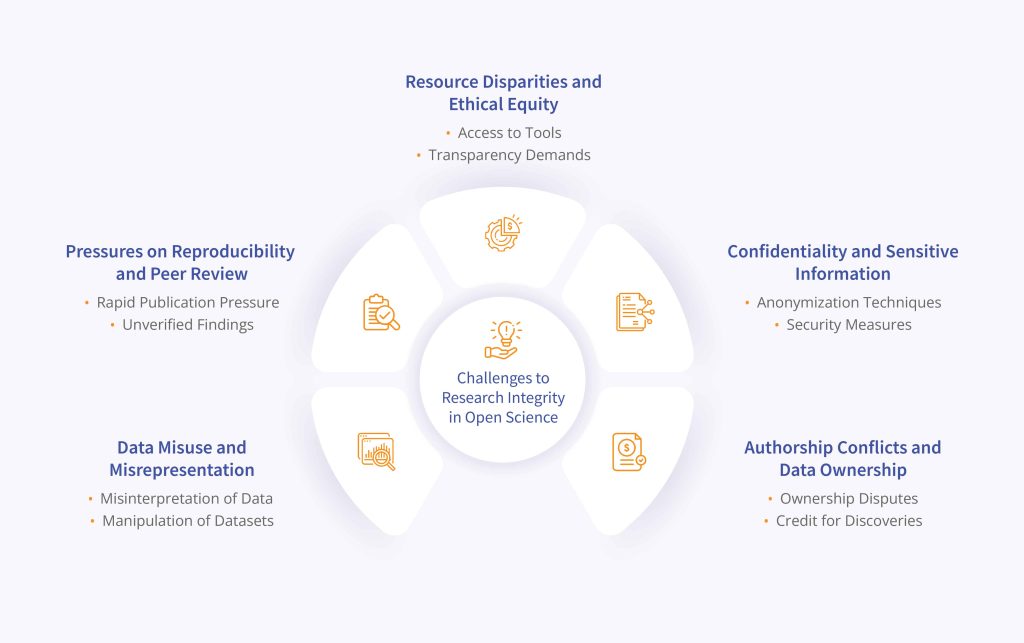
Open science and research integrity challenges

Building Responsible Open Science Practices

The challenges associated with open science are not insurmountable, but addressing them requires a deliberate focus on ethical education and training. By equipping researchers with the knowledge and tools to navigate the complexities of open ecosystems, institutions can uphold research integrity while fostering a culture of responsible scientific inquiry.

Core Competencies for Open Science Practitioners

Effective ethical education should focus on building core competencies that researchers need in open science environments:

  • Data Stewardship: Ensuring data is anonymized, securely stored, and shared responsibly.
  • Transparency Skills: Developing practices for clear documentation of methods, decisions, and datasets.
  • Critical Evaluation: Training researchers to assess the reliability of open-access findings and their applicability.
  • Collaboration Ethics: Preparing researchers to navigate authorship and contribution disputes in collaborative projects.
Incorporating FAIR Principles into Training

The FAIR principles provide a structured framework for data management in open science. By integrating these principles into ethical training, researchers learn how to make their work accessible while maintaining high standards of integrity.

Incorporating Technological Solutions

Innovative tools like persistent identifiers (e.g., ORCID) can assure the provenance of research contributions, bolstering transparency and accountability. Additionally, preprint validation systems represents new frontiers in verifying research integrity prior to publication.

Bridging the Gap: Institutional and Policy-Level Solutions

To ensure the seamless integration of research integrity into open science, institutions and policymakers must provide structural support. Comprehensive guidelines, global collaboration, and equitable resource distribution form the foundation for addressing systemic challenges.

Strategic Recommendations

Strengthening research integrity in open science requires a multifaceted approach that combines institutional support, global collaboration, and cutting-edge technology. The following strategies outline a path forward:

  1. Institutional Alignment: Align institutional policies with global frameworks such as UNESCO’s Open Science Recommendation.
  2. Global Collaboration: Participate in initiatives like United to Act which focus on addressing systemic issues such as paper mills and reproducibility.
  3. Open Peer Review Enhancement: Advocate for transparent peer-review systems to improve the quality and integrity of evaluations.
  4. Educational Interventions: Develop and implement ethical training programs emphasizing real-world scenarios to address intentional and unintentional misconduct.
  5. Technological Integration: Promote the use of advanced tools like persistent identifiers (e.g., ORCID) and FAIR-compliant data practices to future-proof open science efforts.

Ethical Preparedness as a Pillar of Open Science

Achieving a balance between transparency and ethical rigor in open science is essential for maintaining research integrity. Institutions and policymakers must prioritize ethical frameworks, invest in advanced tools, and foster collaboration across sectors to ensure openness does not compromise reliability.

To safeguard the credibility of scientific findings, the academic community must embed accountability into every stage of the research process. By championing innovations such as blockchain and AI while strengthening global partnerships, open science can become a model of transparent and principled research. This collective effort ensures not only the sustainability of open science but also its capacity to drive equitable and trustworthy knowledge-sharing for future generations.

Bridging the Gap: Maximizing Collaboration Between Editorial Teams and Journal Editorial Offices

With the pace of change in scholarly publishing accelerating, collaboration between Editorial Teams and Journal Editorial Office (JEO) Teams has become more vital than ever. As publication volumes rise and quality standards tighten, the lines between these two teams are blurring, creating exciting opportunities for synergy. In this article, we explore how these two groups can work hand-in-hand to enhance both efficiency and academic rigor in the publishing process.

The Modern Editorial Ecosystem: A New Era of Publishing

The scholarly publishing workflow has grown more intricate, demanding a delicate balance between maintaining academic excellence and ensuring operational efficiency. At the heart of this evolving ecosystem are two critical, yet interconnected, teams: the Editorial Team, which focuses on academic quality and strategy, and the JEO Team, which ensures the smooth operational execution of the publication process. Together, they form the backbone of any successful journal.

The Editorial Team: Guardians of Academic Integrity and Excellence

The Editorial Team is where academic rigor meets strategy. Comprising academic editors, subject matter experts, and dedicated editorial staff, this team is tasked with:

  • Defining the Journal’s Vision: Setting the direction and maintaining the journal’s academic scope, impact, and reputation.
  • Ensuring Academic Quality: Assessing the novelty, methodology, and potential impact of submitted manuscripts.
  • Leading Peer Review and Decision-making: Carefully selecting appropriate reviewers and integrating their feedback in the decision to ensure the highest standards of quality.
  • Ethical Oversight: Upholding publishing ethics and ensuring research integrity is maintained at every stage.

The JEO Team: The Operational Backbone of the Publishing Process

While the Editorial Team focuses on academic excellence, the JEO Team is the engine that keeps everything running smoothly. Often working behind the scenes, this team ensures that processes are streamlined and deadlines are met. Their expertise includes:

  • Submission Management: Handling manuscript tracking systems and ensuring technical compliance with submission guidelines.
  • Optimizing Processes: From submission to final decision, they ensure workflows are efficient and organized.
  • Stakeholder Communication: Acting as the central point of contact, they coordinate between authors, reviewers, and editors to keep everyone in the loop.
  • Quality Assurance: Running technical checks and ensuring consistency throughout the publishing process.

Revolutionizing the Editorial-JEO Partnership: The Key to Success

The successful journals of today are tearing down the traditional walls between the Editorial Team and the JEO Team. By embracing a more integrated approach, these teams can:

Redefine Traditional Boundaries

Rather than sticking to rigid roles, many journals are finding success by:

  • Creating flexible role definitions that can adapt to high-volume periods.
  • Introducing hybrid positions that combine both academic and operational responsibilities.
  • Cross-training team members to foster mutual understanding and appreciation of each other’s roles.
Harnessing Technology as a Collaboration Catalyst

Technology has become the bridge between Editorial and JEO teams, helping to streamline workflows and enhance collaboration. While traditional manuscript management systems like ScholarOne and Editorial Manager are staples in the industry, cutting-edge tools are taking collaboration to the next level by:

  • Integrating project management software for enhanced visibility and real-time monitoring.
  • Implementing automated quality control systems to ensure consistency at every stage.
  • Using data analytics to pinpoint bottlenecks and optimize the publishing process.
Reinventing Quality Control

Quality control in modern publishing goes far beyond traditional checks. Leading journals are embracing innovations that leverage both teams’ strengths, such as:

  • AI-powered plagiarism detection and reference checking to speed up the screening process.
  • Creating tiered screening processes that engage both teams at different stages of the manuscript review.
  • Developing comprehensive quality metrics that span both academic rigor and operational efficiency.

Best Practices for Enhanced Collaboration: Tips for Building a Stronger Partnership

To foster a more effective and seamless relationship between Editorial Teams and JEO Teams, journals can implement a few best practices:

Strategic Planning
  • Clear Communication Protocols: Establish joint strategy sessions, share access to performance dashboards, and create structured feedback mechanisms to ensure transparency.
  • Develop Standard Operating Procedures (SOPs): Define clear handoff points, set escalation protocols, and prepare contingency plans for high-volume periods.
Performance Optimization
  • Monitor Key Performance Indicators (KPIs): Track metrics such as submission-to-first-decision time, reviewer acceptance rates, author satisfaction, and technical compliance.
  • Implement Regular Quality Audits: Regularly review manuscript processing, assess peer review quality, and gather feedback through author experience surveys.

Future-Proofing the Partnership: Staying Ahead of the Curve

As the landscape of scholarly publishing continues to evolve, successful journals will need to stay ahead of the game. To do so, they must:

Embrace Technological Innovation
  • Integrate AI for Preliminary Screening: Use machine learning tools to automate manuscript screening for basic compliance and quality checks.
  • Adopt Predictive Analytics: Leverage data to predict submission trends, reviewer availability, and bottlenecks to optimize workflows.
  • Implement Blockchain for Transparency: Blockchain technology can offer greater transparency and security in the publishing process, ensuring ethical standards are met.
Invest in Team Development
  • Cross-Functional Training Programs: Equip team members with knowledge across both academic and operational areas to build a more flexible, efficient workforce.
  • Build Expertise in Emerging Technologies: Stay on top of the latest publishing trends and technologies to ensure your teams are always prepared for the future.
  • Develop Leadership Across Both Teams: Encourage leadership development within both the Editorial and JEO teams to build stronger, more collaborative leadership structures.

Conclusion: A New Era of Scholarly Publishing

The future of scholarly publishing is about collaboration. By breaking down traditional silos and fostering a more integrated approach between Editorial and JEO teams, journals can create an environment that is not only more efficient but also academically rigorous. With a focus on technology, streamlined processes, and team development, the collaboration between these two teams can become the cornerstone of successful, future-proofed publishing operations.

The key takeaway? Academic excellence and operational efficiency are not opposing forces—they’re complementary strengths that, when aligned, elevate the entire publishing process. By embracing this mindset, journals can deliver top-tier content while ensuring an exceptional experience for authors, reviewers, and readers alike.

Take the Next Step

At Integra, we celebrate the invaluable contributions of editorial professionals and recognize their essential role in advancing the scholarly community. Our advanced tools empower them to continue playing a crucial part in advancing human knowledge through research. As a trusted partner, we offer human expert-led, technology-assisted solutions tailored to editorial, research integrity, and peer review management.

Contact us now to explore how we can help you succeed!

About the Author

Ashutosh Ghildiyal is Vice President – Growth & Strategy at Integra, where he leads enterprise-wide initiatives spanning growth, strategy, marketing, innovation, and AI-driven solutions for scholarly publishing. With nearly 20 years of international leadership experience, he works at the intersection of scholarly publishing, artificial intelligence, and knowledge infrastructure. His interests include AI governance, research integrity, peer review, publishing innovation, and the future of human knowledge systems. Ashutosh hosts Upstream by Integra, a podcast featuring conversations with global leaders shaping the future of scholarly communication. He serves on the Board of Directors of the International Society of Managing and Technical Editors (ISMTE) and is a Chef at The Scholarly Kitchen, where he writes about scholarly communication, AI governance, research integrity, publishing strategy, and the future of knowledge.