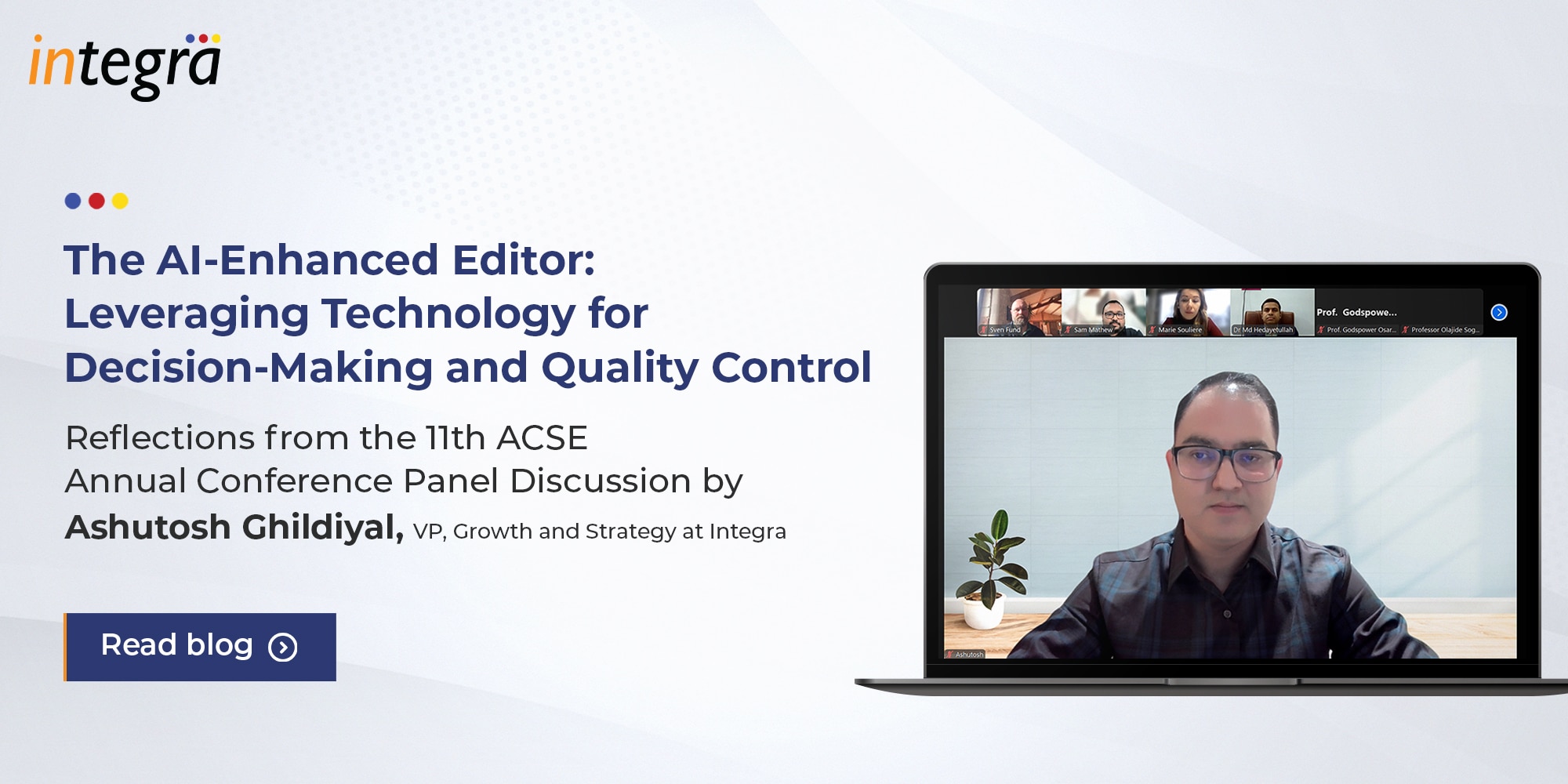
By Ashutosh Ghildiyal, VP of Growth and Strategy, Integra
Panel Discussion at the 11th ACSE Annual Conference (February 25, 2025)
The 11th ACSE Annual Conference, themed “Transforming Scholarly Publishing: Embracing the Future,” featured a thought-provoking panel discussion on “The AI-Enhanced Editor.” I joined esteemed panelists Sven Fund (Reviewer Credits), Martin Delahunty (Inspiring STEM), Sam T Mathew (Asian Council of Science Editors), and Marie Soulière (Frontiers Editorial Office) to examine how AI tools are transforming editorial workflows while maintaining ethical standards.
Understanding AI in Publishing: Beyond the Hype
To understand AI’s role in publishing, we must first define what AI truly is. AI is not “intelligent” in the human sense—it does not possess self-awareness or independent thought. Instead, it represents a form of mechanical intelligence based on memory-driven pattern recognition, language processing, and computational efficiency.
While AI excels at tasks that can be systematically learned and measured, it lacks subjective human faculties like observation, attention, doubt, and creativity. These human elements remain crucial in editorial decision-making and quality control, which is why AI should be seen as an assistant rather than a replacement for editors.
Why Do Editors Need Enhancement?
The concept of an “AI-enhanced editor” does not imply that editors lack capability. Rather, it acknowledges the increasing burden of scale in scholarly publishing. Meaningful engagement with manuscripts takes time, and as submission volumes rise, editors find it increasingly difficult to dedicate necessary attention to each paper.
Editors don’t need enhancement because they lack skill; they need support because they lack time. AI’s primary role is to help manage scale—streamlining decision-making and quality control so editors can focus on their core mission: ensuring the integrity and excellence of published research.
The Vendor’s Role in Scholarly Publishing
As vendors, we are integral to the publishing ecosystem, collaborating with publishers to achieve goals such as cost savings, faster publication times, and research integrity management through technology and human expert services.
“AI is in its infancy and will become more capable through incremental improvements,” I noted during the panel. “While individuals have quickly adapted to AI, businesses have struggled to identify appropriate use cases. Fortunately, in scholarly publishing, the use case is clear: enabling publishers and editors to manage scale while maintaining quality and trust.”
Practical AI Applications in Editorial Workflows
AI has already demonstrated its ability to assist with various editorial functions:
- Manuscript Screening: AI-driven tools conduct language and technical checks to assess a manuscript’s suitability before it reaches an editor.
- Research Integrity Checks: AI can identify plagiarism, image manipulation, and other ethical concerns at different stages of the editorial process (pre-submission, pre-peer review, post-acceptance).
- Reviewer Matching and Selection: AI can analyze research networks and reviewer histories to suggest the most appropriate reviewers for a given manuscript.
- Faster and More Efficient Reviews: AI can automate mundane tasks such as reference checks, statistical validations, and proofreading, enabling reviewers to focus on core scientific content.
By handling these repetitive tasks, AI frees up human editors and reviewers to engage more deeply with manuscripts, leading to improved research quality. In essence, more human attention translates to better science.
AI Implementation at Integra: Real-World Examples
At Integra, we’ve implemented AI solutions throughout the publication workflow, which have:
- Automated previously manual tasks
- Significantly improved quality, accuracy, and efficiency of automated processes
For example:
- Our AI copyediting tool (EditPilot, formerly called iNLP) analyzes manuscripts and categorizes them as requiring no editing, minimal editing, or intensive editing. This categorization saves time and cost while expediting quality manuscript publication.
- • Our AI-based manuscript assessment tool (EditorialPilot) qualifies submissions on language, technical, and research integrity parameters before peer review, saving editors and reviewers valuable time.
Despite AI’s growing importance, the demand for human expert review hasn’t decreased. Instead, hybrid approaches are emerging where humans drive the process with AI assistance. “To succeed in the current landscape, the right equation is using AI for managing scale while improving meaningful human engagement with manuscripts at both editorial and peer review stages.”
Balancing AI Accuracy with Human Oversight
At Integra, we deploy AI only where it outperforms traditional technology, with accuracy improved through fine-tuning. For manuscript screening, AI effectively filters submissions that fail basic requirements, though accuracy depends on training data quality.
In copyediting, AI tools excel at correcting grammar, spelling, and consistency errors, but struggle with subject-specific language and nuance. Currently achieving approximately 94% accuracy, AI-driven editing tools still require human oversight to ensure standards are met. The most effective approach combines AI efficiency with human quality control.
Addressing Confidentiality Concerns
Confidentiality is paramount when incorporating AI into scholarly publishing. Key questions include:
- Where manuscript data is stored
- Who has access to it
- Whether it could be used for AI model training
Safeguards include:
- Strict data agreements with AI vendors
- No-data-retention policies
- Compliance with global regulations like GDPR
Trust remains essential for AI adoption in publishing workflows, requiring demonstrated data governance from vendors.
For authors, AI offers significant benefits, particularly for non-native English speakers, by assisting with language and structural improvements. However, AI is not a magic wand—it requires careful supervision, context-setting, and critical review.
The key takeaway for authors is: AI is DIY (do-it-yourself). To maximize its benefits, authors must be diligent in how they provide input, review AI-generated content, and refine their manuscripts. Authors must provide detailed context and review outputs attentively, critique AI-generated content, and ensure their work remains authentic.
Balancing AI and Human Expertise
As AI adoption grows, so do concerns about its implications. The key is to communicate a balanced, fact-based message about AI’s role. There is both hype and fear surrounding AI—some view it as revolutionary, while others worry about its potential to replace human expertise. The reality lies somewhere in between: AI enhances efficiency and enables scale, but human judgment remains irreplaceable.
At Integra, we are committed to developing AI-powered solutions that support—not replace—human editorial and peer review processes. Our goal is to help publishers, editors, and authors navigate the evolving landscape of scholarly publishing while maintaining the highest standards of research integrity.
AI is here to stay, and its role in scholarly publishing will only expand. However, its greatest value lies in enabling human experts to do their work more effectively. By automating repetitive tasks, supporting decision-making, and enhancing quality control, AI can help publishers uphold the trust and integrity of academic research.
The challenge now is to strike the right balance—leveraging AI where it adds value while ensuring human engagement remains at the heart of scholarly publishing. The future of publishing is not AI versus humans—it is AI and humans working together to advance knowledge and science.
About the Author
Ashutosh Ghildiyal has spent nearly two decades in scholarly publishing, specializing in customer service and business development. He has worked closely with authors, institutions, and publishers, with a strong focus on establishing and scaling international businesses in markets such as China, South Korea, Saudi Arabia, and India.
As VP of Growth and Strategy at Integra, Ashutosh partners with scholarly publishers and societies to enhance both upstream and downstream workflows. Integra’s expertise includes manuscript screening, research integrity, peer review, and production, combining AI-driven solutions with expert-led services to optimize publishing processes.
Passionate about AI’s role in improving peer review, Ashutosh has authored several articles on reviewer fatigue and AI-driven efficiencies in scholarly publishing.